Guide · Project documents

How a quantity becomes a payment, and what proves it.

Twelve documents carry every public road and bridge project, whatever your agency calls them. Follow 148.2 tons of asphalt overlay placed on a county road on 16 June, from the inspector's daily report to the final estimate.

Each document below has what it's for, who makes it and who signs it off, and the real HeadLight form behind it. For how they sit across a whole project, see one project, six records.

How the twelve documents of a project connect Pay: daily report to quantity record to pay estimate to final estimate. Time: project diary to statement of working days, which feeds the pay estimate; punch list feeds the final estimate. Materials: test report feeds the pay estimate and the materials certification. Changes: RFI to authorization to proceed to change order, which feeds the pay estimate. PAYTIMEMATERIALSCHANGES days charged accepted before paid priced Daily report Quantity record Pay estimate Final estimate Project diary Statement ofworking days Punch list Test report Materialscertification RFI Authorizationto proceed Change order ● carries the 148.2 tons · select any document to jump to it
  • PayDaily report → quantity record → pay estimate → final estimate
  • TimeProject diary → statement of working days → pay estimate. Punch list → final estimate.
  • MaterialsTest report → accepted before paid on the pay estimate → materials certification
  • ChangesRFI → authorization to proceed → change order → priced on the pay estimate

Every day

Illustrative product view · example data

Daily report

Also called: Daily work report, inspector's daily report, daily inspection report

Who makes it
The inspector, the same day, by the person who saw the work.
Who signs off
The resident engineer, usually the next morning.
Why it matters
The 148.2 tons on this report is what gets paid. It's also the record of contract time and the first thing anyone reads in a dispute. Once approved, it's kept as it was approved.
Field Data
See the real form
Part of the daily report form in HeadLight, made-up project 123
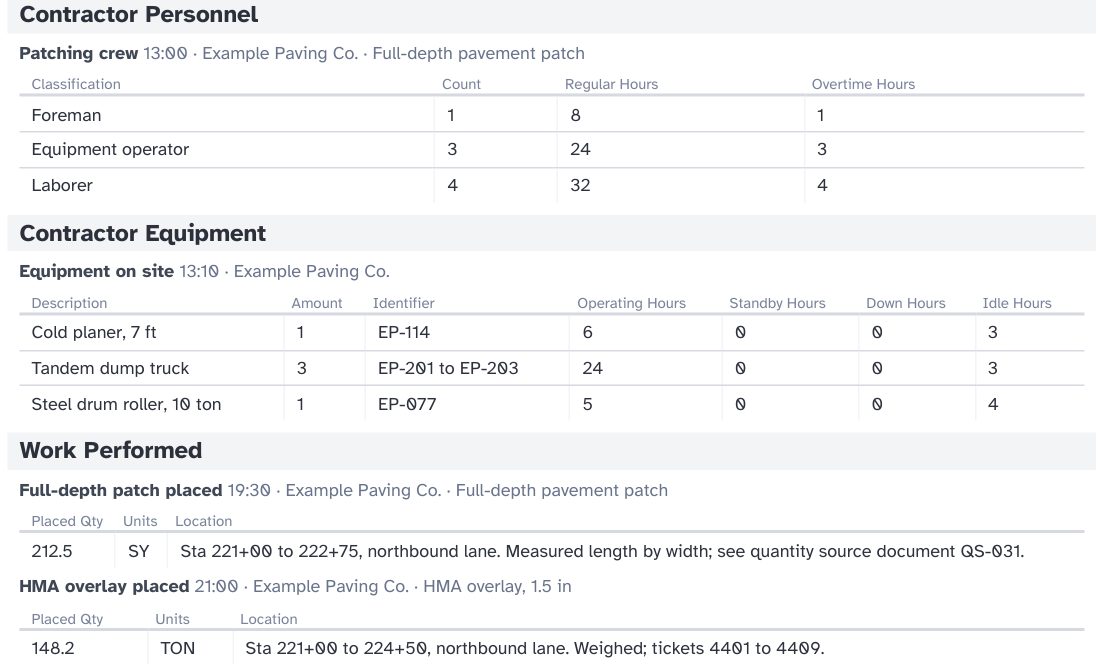
  1. Crews and equipment are recorded by firm, with the time they were seen.
  2. Standby and down hours: what a delay claim gets checked against later.
  3. The placed quantity, with its location and the tickets behind it. This is the line that gets paid.

Part of the form, on a made-up county road project. Select it to see it at full size.
Illustrative product view · example data

Project diary

Also called: Engineer's diary, contract diary, daily construction log

Who makes it
The resident engineer, one entry per contract day for the whole job.
Who signs off
Kept by the resident engineer; read by the district.
Why it matters
It says whether each day counted against contract time, and notes the delays, instructions and visitors that matter later.
Field Data
See the real form
Part of the project diary form in HeadLight, made-up project 1234
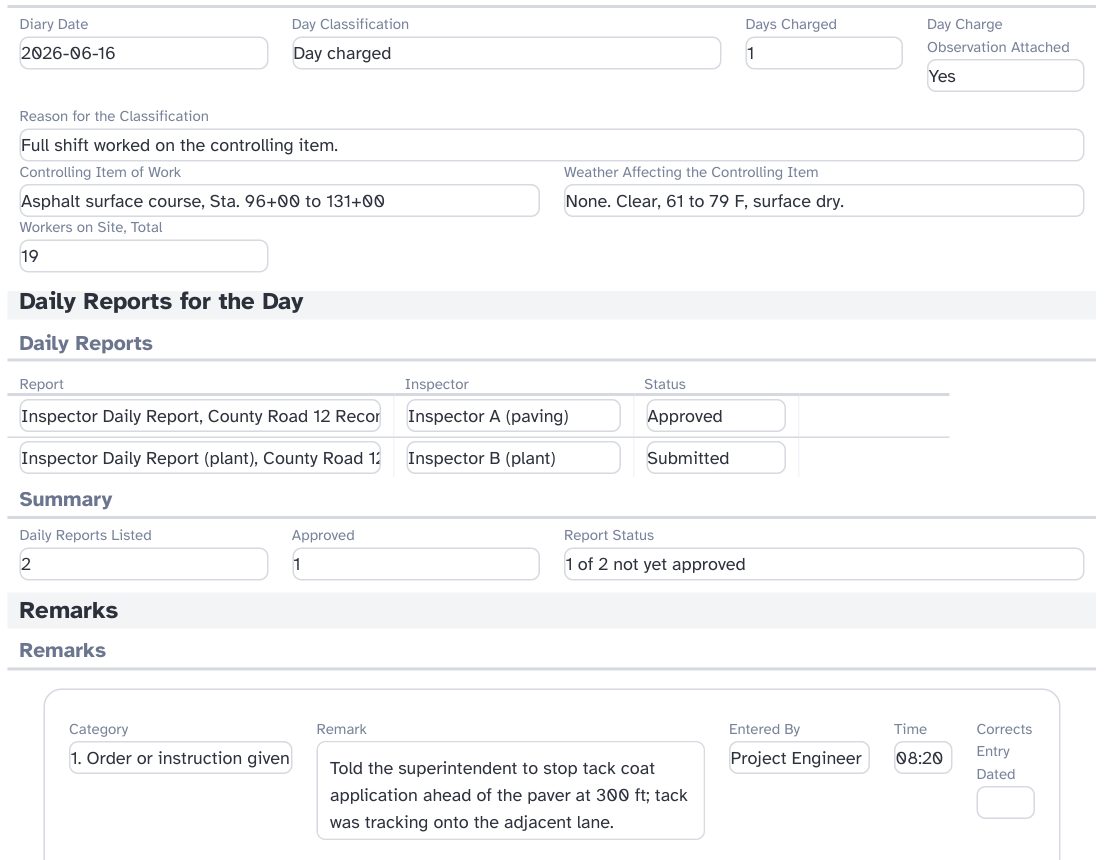
  1. Each day is classed as charged or not, against contract time.
  2. The controlling item of work, and whether the weather affected it.
  3. The day's inspector reports, and which are still waiting for approval.
  4. Instructions, meetings and calls, logged with who and when.

Part of the form, on a made-up county road project. Select it to see it at full size.
Illustrative product view · example data

Quantity record

Also called: Quantity sheet, item record, source document

Who makes it
The inspector, from a ticket, a survey or a tape.
Who signs off
The resident engineer, with the daily it came from.
Why it matters
Nothing is paid that wasn't first measured. Each quantity points back to the document behind it.
Field Data
See the real form
Part of the quantity record form in HeadLight, made-up project 1234
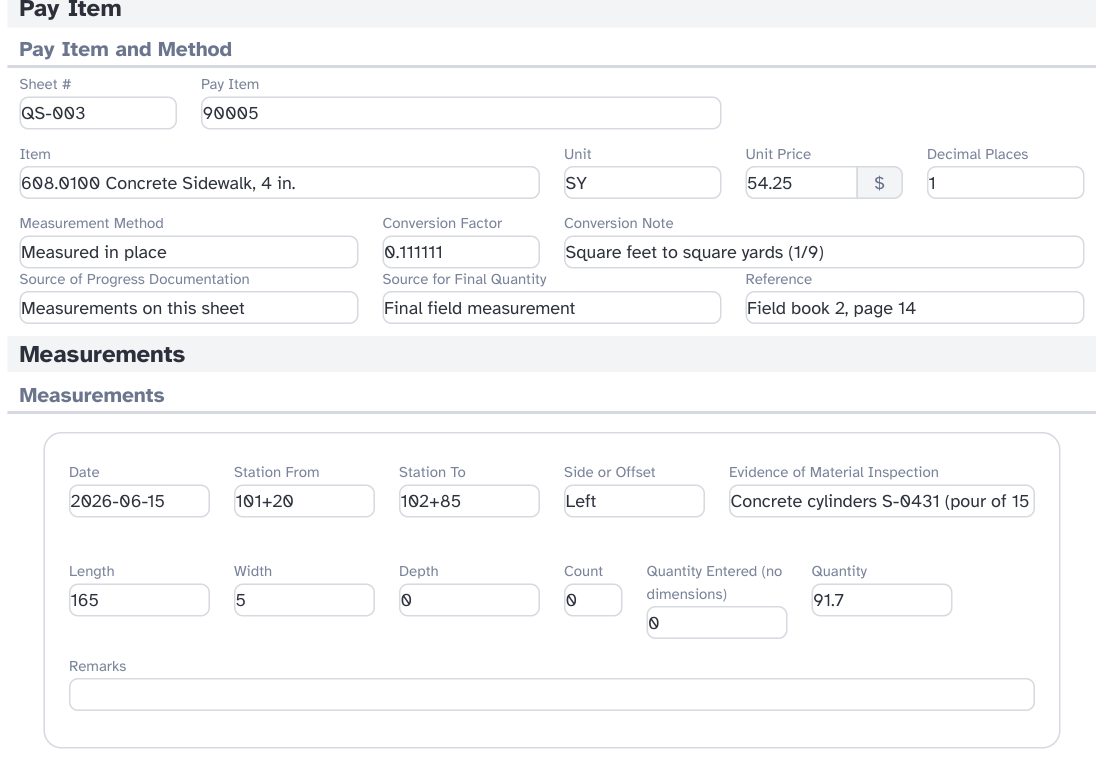
  1. The pay item and its unit price, straight from the contract.
  2. How it was measured, and where the record of it lives.
  3. Each measurement is tied to its location and to the test that accepted the material.
  4. The quantity, worked out from the dimensions.

Part of the form, on a made-up county road project. Select it to see it at full size.
Every week

Illustrative product view · example data

Statement of working days

Also called: Weekly statement, working day report

Who makes it
The resident engineer, from the diary.
Who signs off
Sent to the contractor, who can protest within a set number of days.
Why it matters
It keeps the time count agreed as the job goes, so working days and late charges aren't a surprise at the end.
Field Data
See the real form
Part of the statement of working days form in HeadLight, made-up project 1234
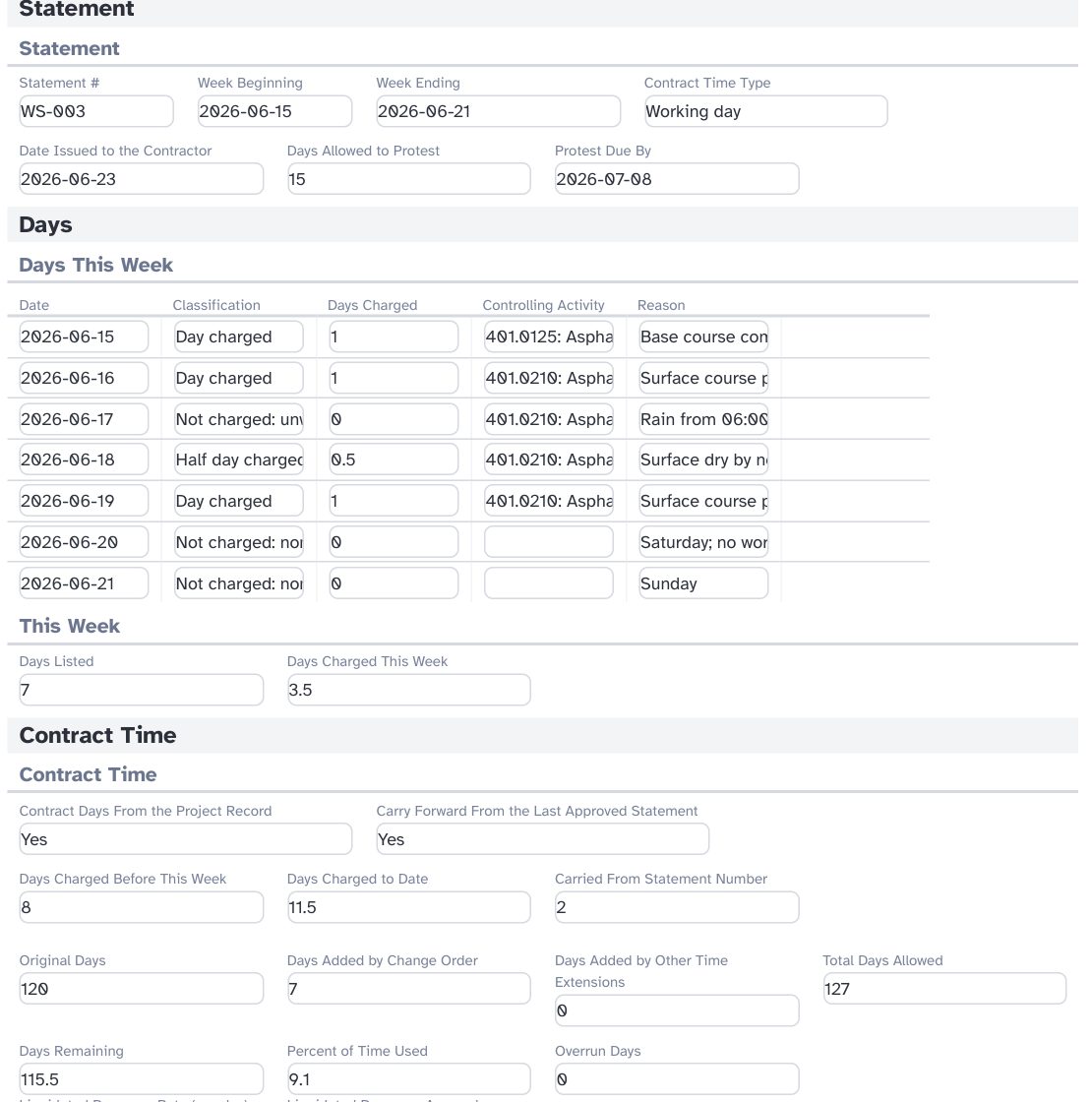
  1. The contractor's window to protest the count.
  2. Each day classed: charged, not charged or half a day, with the reason.
  3. Days added by change order move the total allowed.
  4. Days remaining: the number that decides late charges.

Part of the form, on a made-up county road project. Select it to see it at full size.
When the work changes

Illustrative product view · example data

Request for information

Also called: RFI, design question

Who makes it
The contractor, when the plans raise a question.
Who signs off
Answered by the designer, through the resident engineer.
Why it matters
It keeps design decisions with the engineer of record, and it's often where a change starts.
Field Data
See the real form
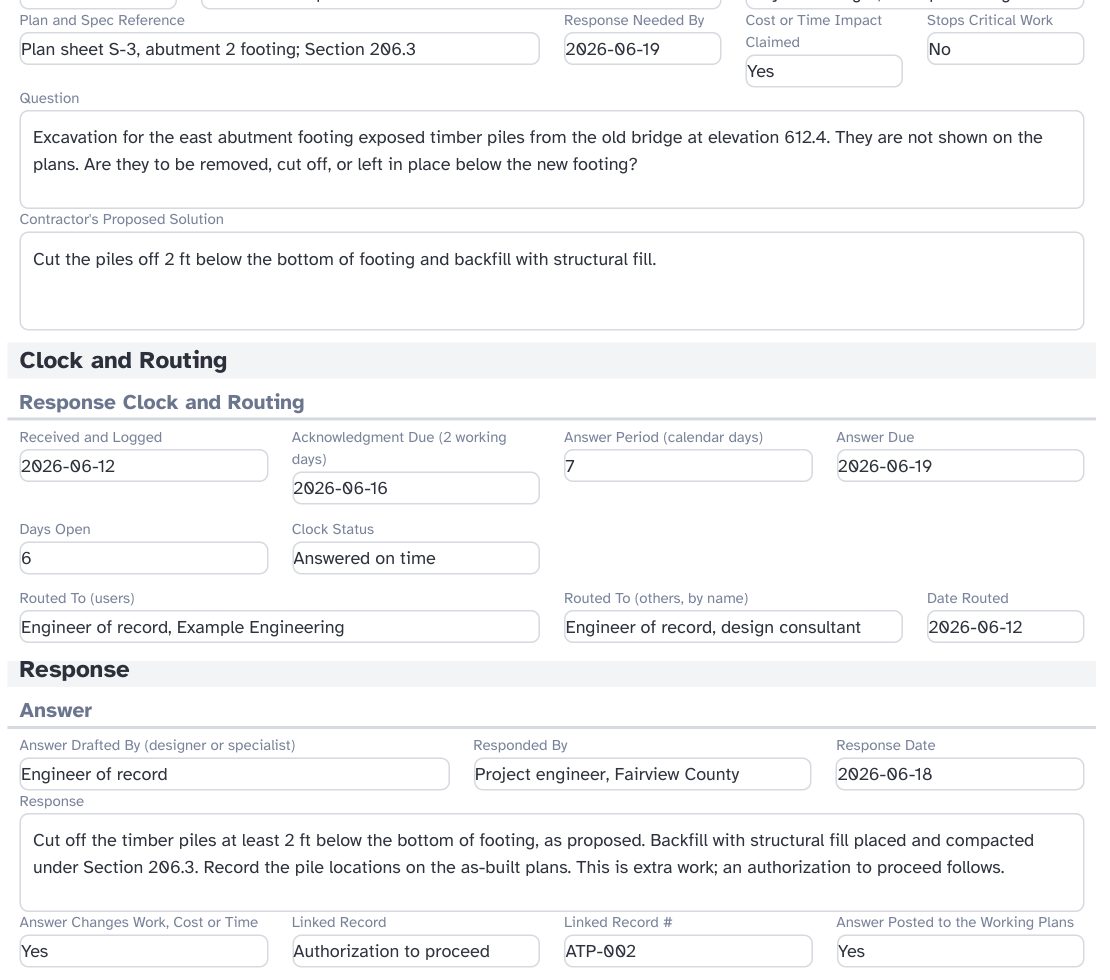
Part of the request for information form in HeadLight, made-up project 1234
  1. The question, tied to the plan sheet and spec section it's about.
  2. The answer clock: when it's due, and whether it was met.
  3. Drafted by the designer, given to the contractor by the resident engineer.
  4. An answer that changes the work links straight to the authorization that follows.

Part of the form, on a made-up county road project. Select it to see it at full size.
Illustrative product view · example data

Authorization to proceed

Also called: Directive, interim work authorization, field order

Who makes it
The resident engineer, often the day a problem is found.
Who signs off
Within the resident engineer's limit, with a not-to-exceed amount.
Why it matters
The work keeps moving before the change order is written, and the extra work is recorded every day after.
Field Data
See the real form
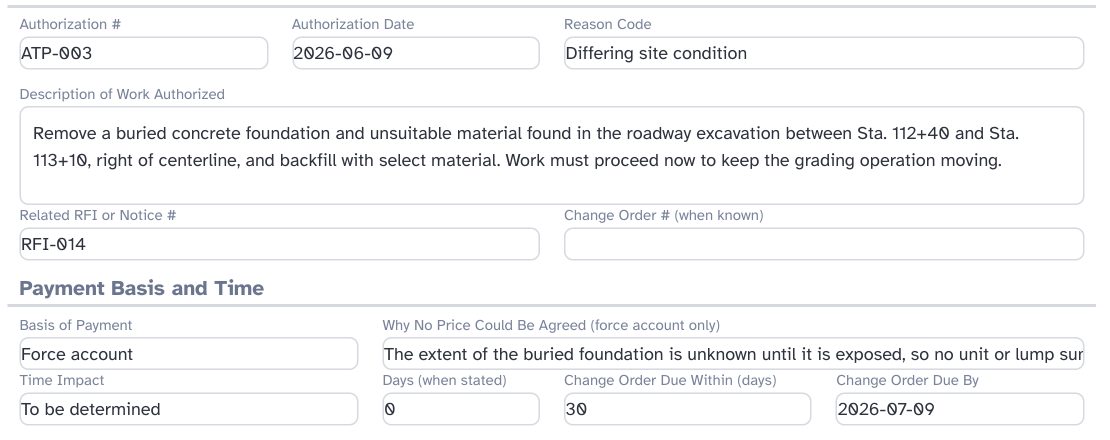
Part of the authorization to proceed form in HeadLight, made-up project 123
  1. Why the work is needed: here, a site condition the plans didn't show.
  2. How it'll be paid: force account, recorded daily until a price is agreed.
  3. The change order is due within a set number of days.

Part of the form, on a made-up county road project. Select it to see it at full size.
Illustrative product view · example data

Change order

Also called: Supplemental agreement, extra work order, contract modification

Who makes it
The resident engineer, with the agency's own cost estimate.
Who signs off
Up the approval chain by dollar amount.
Why it matters
It's the only way to change the contract's work, price or time, and it has to show every extra dollar was necessary and approved.
Field Data
See the real form
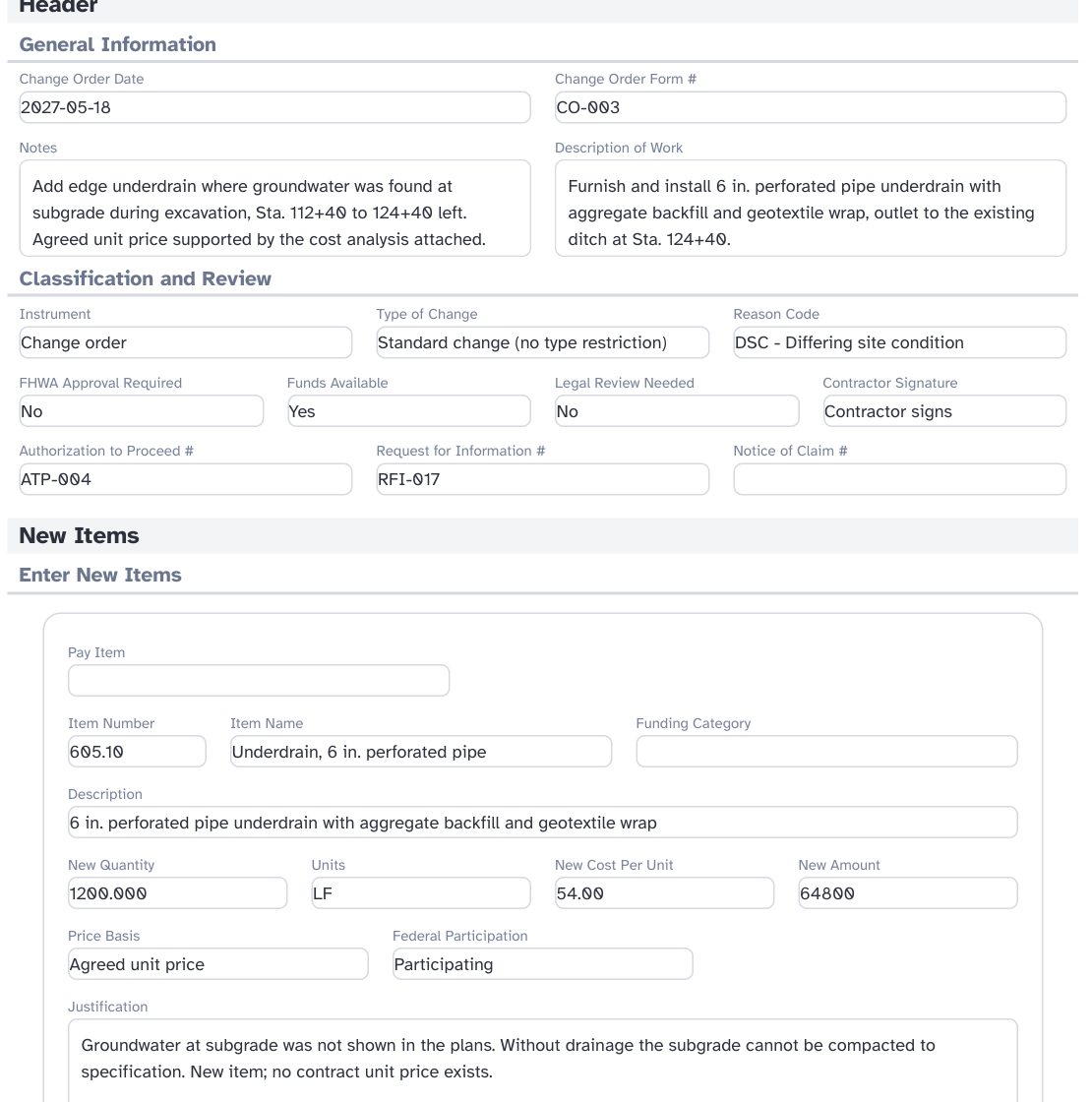
Part of the change order form in HeadLight, made-up project 1234
  1. Why the change is needed, in plain words.
  2. Classified by type and reason, with the checks for funds and federal approval.
  3. Linked to the authorization and the RFI it came from.
  4. The new item's price, how it was set, and the justification.

Part of the form, on a made-up county road project. Select it to see it at full size.
Each sample

Illustrative product view · example data

Test report

Also called: Lab report, field test record

Who makes it
The technician who ran the test.
Who signs off
Released by someone other than the tester, often the lab supervisor.
Why it matters
It decides whether the asphalt on the pay estimate is accepted, and it ends up on the materials certification.
Materials
See the real form
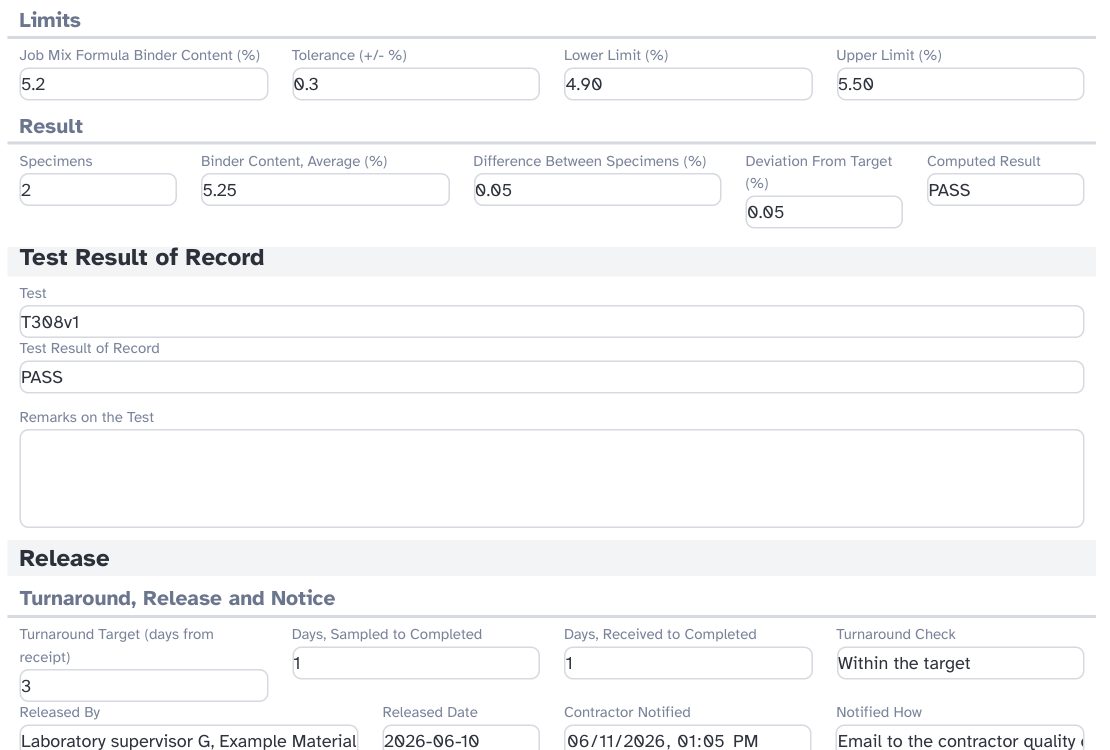
Part of the test report form in HeadLight, made-up project 1234
  1. The limits come from the approved mix design, not typed in by the tester.
  2. Pass or fail is worked out against the spec as the result is entered.
  3. The contractor is told the same day, which starts the retest window.
  4. Released by the lab supervisor, someone other than the tester.

Part of the form, on a made-up county road project. Select it to see it at full size.
Each pay period

Illustrative product view · example data

Pay estimate

Also called: Progress estimate, monthly estimate, partial payment

Who makes it
The project office, at the cutoff date, from approved quantities.
Who signs off
Reviewed by the contractor, then approved up the chain.
Why it matters
Quantity to date times unit price, minus what was paid before. Every line opens to the dailies behind it, and it's checked before it's paid.
Field Data
See the real form
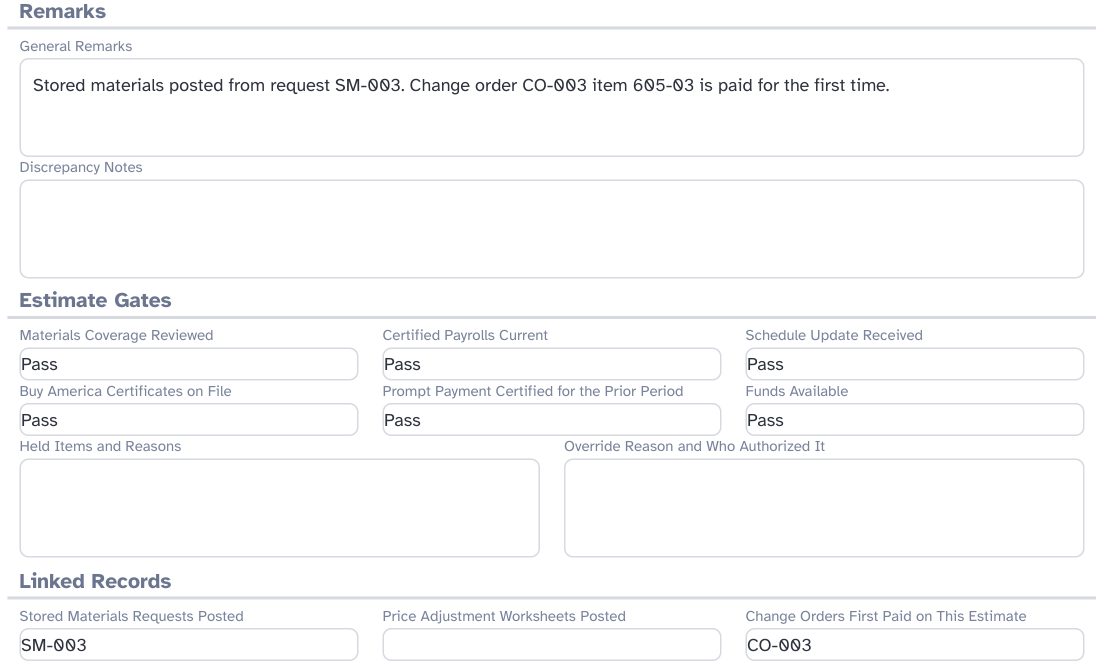
Part of the pay estimate form in HeadLight, made-up project 123
  1. What's new this period, in plain words: stored materials posted, and a change order paid for the first time.
  2. The checks before payment, each confirmed by the office: materials, payrolls, Buy America certificates, prompt pay, schedule, funds.
  3. The records this estimate pays, linked: the stored materials request and the change order.

Part of the form, on a made-up county road project. Select it to see it at full size.
At completion and closeout

Illustrative product view · example data

Punch list

Also called: Final inspection list, deficiency list

Who makes it
The resident engineer and the agency, at the final walk-through.
Who signs off
Closed item by item as the contractor fixes them.
Why it matters
It's what stands between finished work and accepted work.
Field Data
See the real form
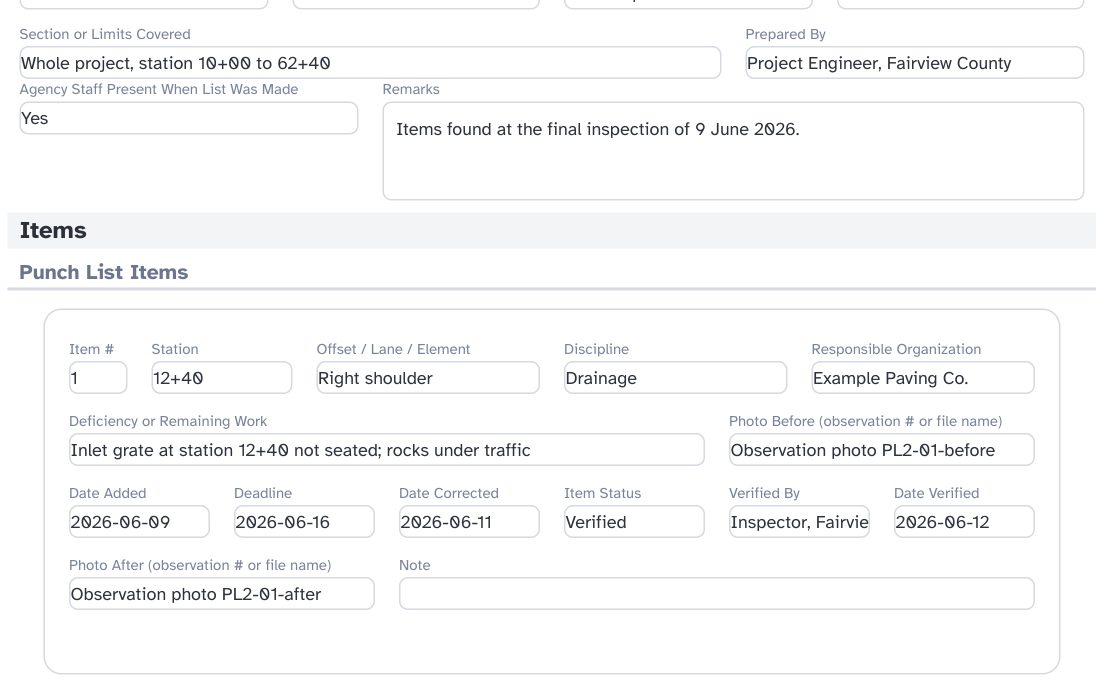
Part of the punch list form in HeadLight, made-up project 1234
  1. The walk-through: what it covered, who was there and who wrote it up.
  2. Each item: where it is, what's wrong and whose it is to fix.
  3. Photos before and after, from the day's observations.
  4. Checked off by the inspector, with the date.

Part of the form, on a made-up county road project. Select it to see it at full size.
Illustrative product view · example data

Final estimate

Also called: Final payment, final pay quantities

Who makes it
The resident engineer and the contractor, once final quantities are agreed.
Who signs off
Approved and paid once, with every overrun and underrun explained.
Why it matters
It ends the contractor's main obligations and starts the record retention clock.
Field Data
See the real form
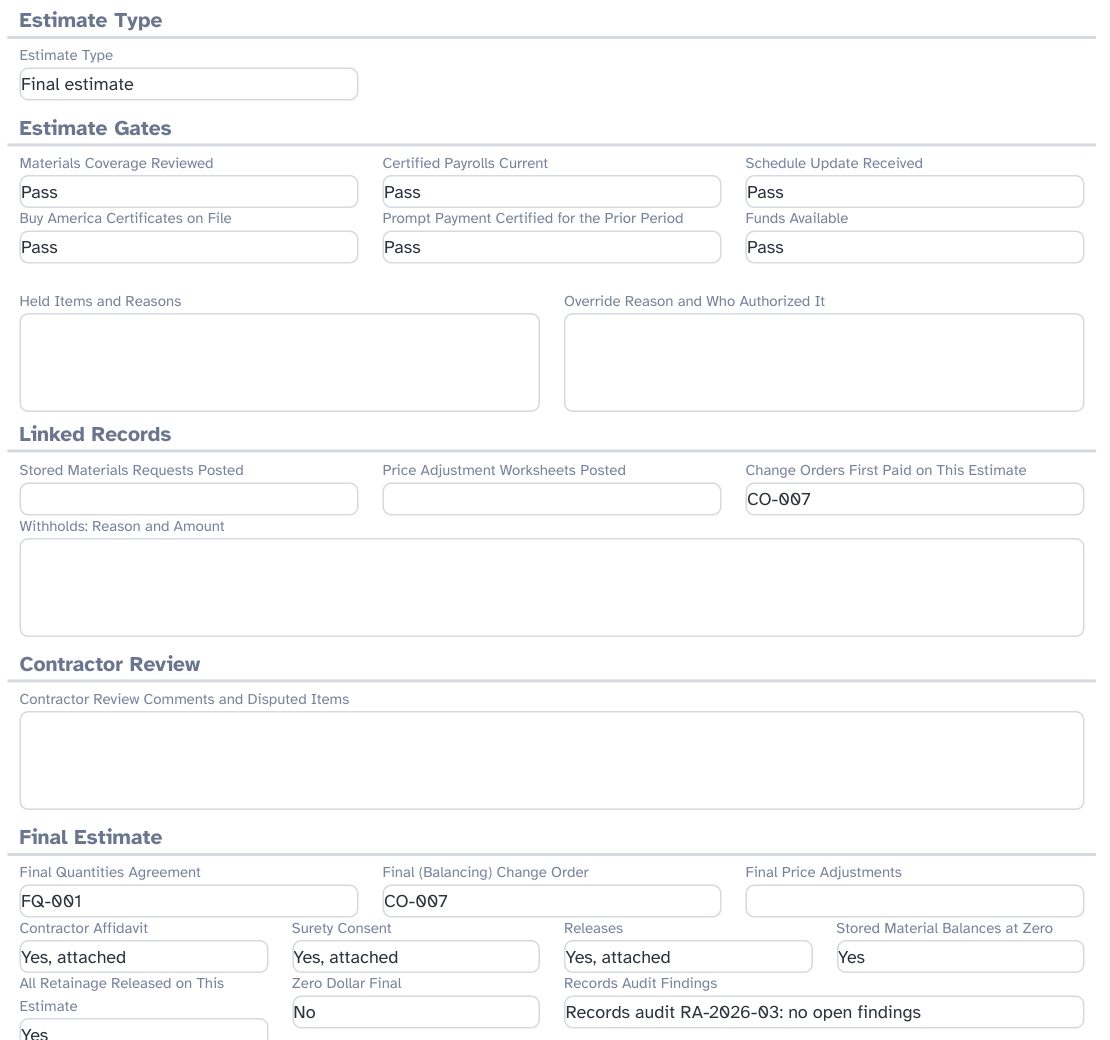
Part of the final estimate form in HeadLight, made-up project 1234
  1. Marked final: paid once and for all.
  2. The same checks as every pay estimate, confirmed one last time.
  3. Built on the final quantities the contractor agreed, and the balancing change order.
  4. Surety consent, releases and the contractor's affidavit, on the record before payment.

Part of the form, on a made-up county road project. Select it to see it at full size.
Illustrative product view · example data

Materials certification

Also called: Materials certificate, contract materials checklist

Who makes it
The materials engineer, from the project's acceptance plan.
Who signs off
Signed by the agency; on federal-aid work, sent on to the state.
Why it matters
It says every material built in was accepted as the contract required, and explains each exception.
Materials
See the real form
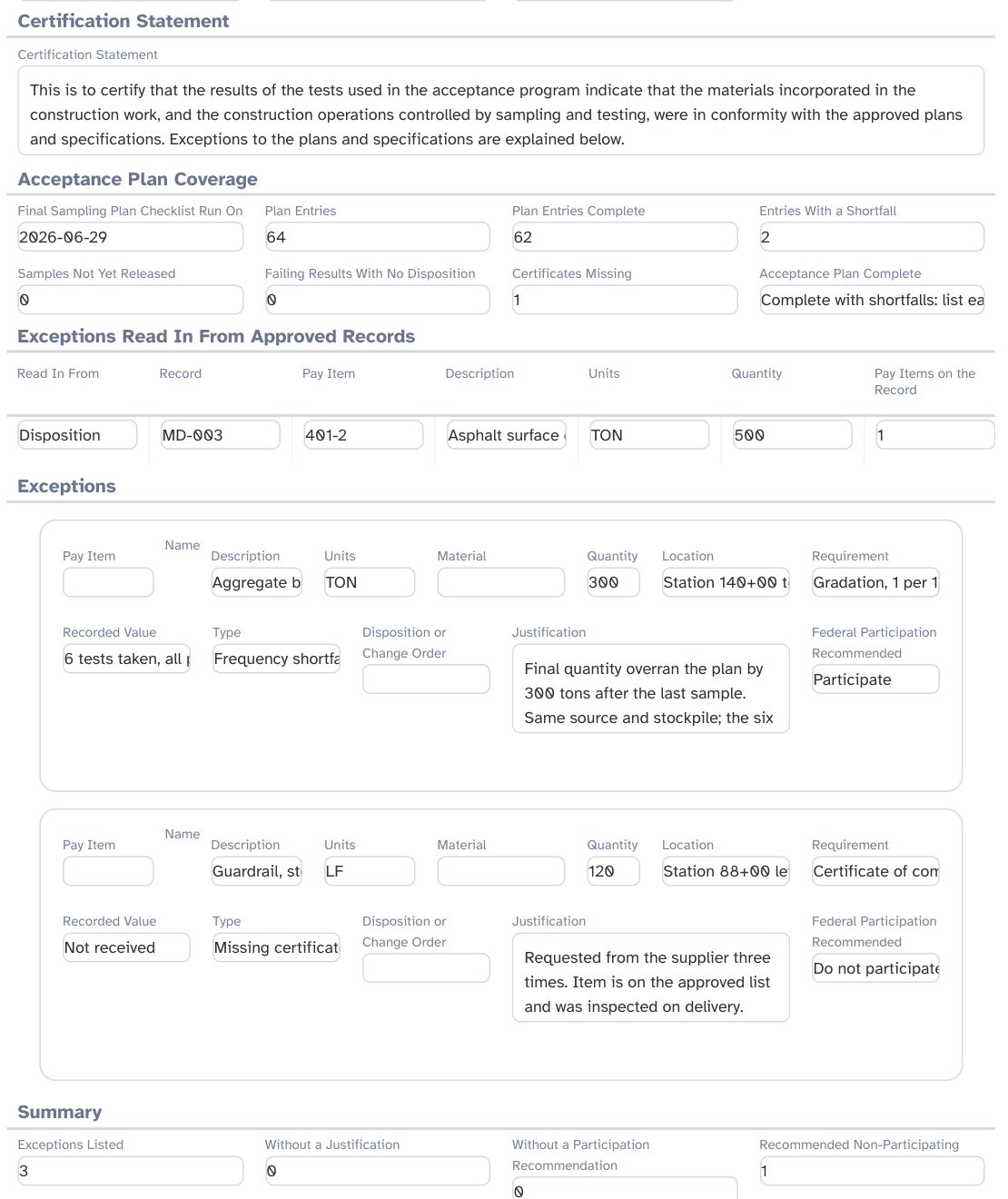
Part of the materials certification form in HeadLight, made-up project 1234
  1. The statement the agency signs: the materials conformed to the plans and specifications.
  2. The acceptance plan, run one last time: 64 requirements, 62 complete, 2 with a shortfall.
  3. Exceptions read in from approved records, such as a lot kept after a failed test.
  4. Each exception explained, with a recommendation on federal participation.

Part of the form, on a made-up county road project. Select it to see it at full size.
HeadLight and agency staff walking a site

Your names, your layouts.

Your daily report, your pay estimate and your agency's forms are set up in HeadLight the way you file them, so nobody keeps a spreadsheet on the side.